Oscillating Knife Cutting Machine for Custom Foam Packaging Inserts
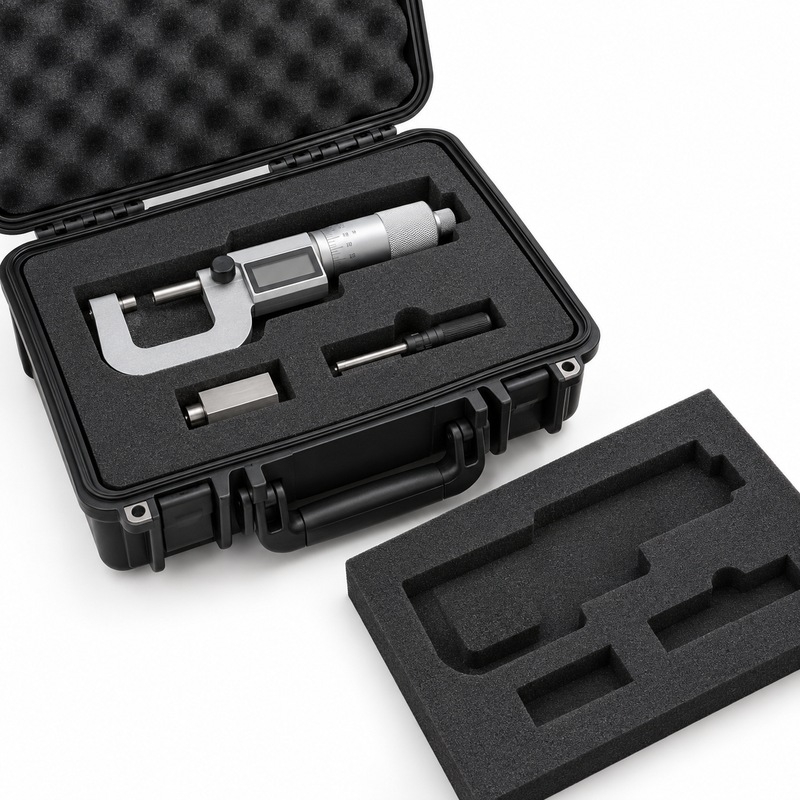
An oscillating knife cutting machine uses a rapidly reciprocating blade and CNC-controlled movement to cut suitable foam sheets into programmed shapes. For custom packaging, it can produce outer profiles, product-shaped openings, and separate layers that assemble into protective inserts.
The right result depends on the foam grade, blade, tool clearance, material hold-down, and tested cutting settings. A material name alone does not establish whether a particular machine can cut it successfully.
What Are Custom Foam Packaging Inserts?
Custom foam packaging inserts are shaped cushioning components fitted inside boxes, cases, or drawers. Their openings locate products and separate accessories, while the surrounding foam provides support.
A useful insert balances product retention, easy removal, cushioning, and the available package space. A tight-looking cavity does not by itself prove that the package will protect its contents during transport.
The operator prepares a two-dimensional drawing and assigns cutting paths. The machine moves the oscillating blade along those paths while the foam is held on the cutting table. After cutting, the operator removes waste and checks the finished pieces.
Straight blade cutting is best understood as a method for producing profiles and cut-through layers. A stepped cavity can be assembled from layers with different openings over a solid base. Continuous curved recesses, undercuts, and complex three-dimensional pockets may require another process or additional equipment.
Which Foam Materials Should Be Tested?
PE, EVA, and PU foam are useful starting points for a packaging material discussion. However, grades vary in density, firmness, cell structure, surface finish, and recovery after compression. These differences affect both cutting behavior and packaging performance.
- PE foam: Consider it for shaped protective inserts, then test edge quality and product fit on the actual grade.
- EVA foam: Consider it for presentation inserts and tool organization where the chosen grade provides suitable support.
- PU foam: Consider it for cushioning applications, while checking compression and stability during cutting.
Request a sample cut using your actual foam, thickness, and drawing. Confirm blade suitability and available cutting clearance before specifying a machine. Electronics packaging may also require verified antistatic or ESD properties; ordinary foam should not be assumed to provide them.
Protective Foam Inserts for Instruments and Equipment
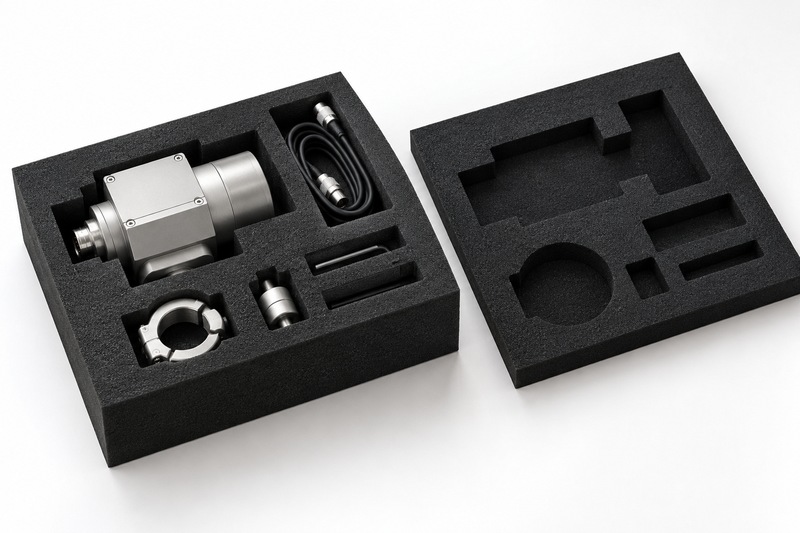
Measuring instruments, sensors, and industrial accessories often need separate locations inside a transport case. A custom insert can accommodate the main product, cable, adapter, and spare components in one layout.
Support robust areas of the product and leave clearance around delicate connectors or controls. Add finger-access notches where appropriate. Check that the lid closes without applying unwanted pressure to the instrument.
Evaluate the complete package, including the case, lid cushioning, insert, and product. Dimensional fit and appearance are only part of transport protection.
Tool Drawer Foam Inserts for Organized Storage
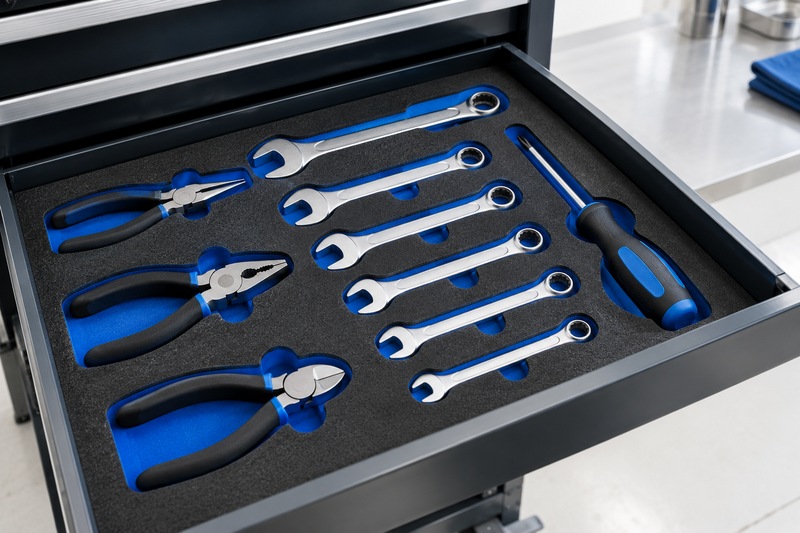
Foam inserts can give hand tools defined positions in workshop drawers and service cases. Contrasting layers can make an empty position easier to see.
Prepare outlines from measured tool profiles and add practical removal access. Leave enough foam between neighboring openings to prevent fragile strips. For layered designs, check that the base and any bonding method suit the intended environment.
Before repeating the design, test whether users can remove and replace each tool easily without stretching or tearing the insert.
Layered Foam Packaging for Product Shipping
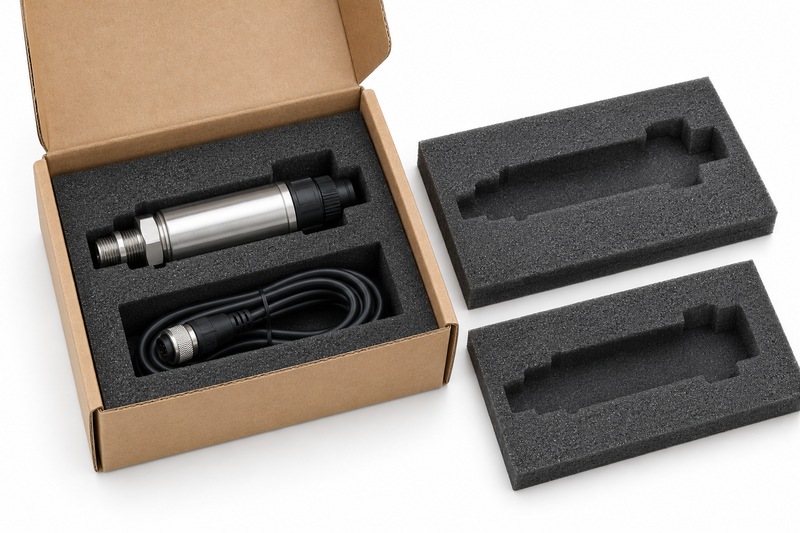
Layered construction creates different support heights from flat sheets. A solid base supports the product, while upper layers provide openings sized for different parts of its profile.
For example, a cylindrical sensor can sit in an upper profile layer above a smaller opening or solid support layer. A separate cavity can keep its cable away from the sensor body.
Approve layer alignment, assembled depth, and the bonding or retention method before production. Check that loose layers cannot shift in normal use. Where shipping protection is required, validate the assembled package under appropriate handling and transport conditions.
From Drawing to Approved Foam Insert
1. Define the package. Record the product size, weight, fragile features, case dimensions, and handling conditions.
2. Select the foam. Confirm the grade, thickness, cushioning needs, and any special material requirements.
3. Prepare the drawing. Check units, closed contours, duplicate lines, finger access, and minimum wall widths.
4. Plan the layers. Separate through-cut profiles from features requiring another process.
5. Make a sample. Check hold-down, blade condition, depth, and settings using the actual material.
6. Inspect and fit the product. Examine the top and bottom edges, cavity size, support, and removal access.
7. Approve and record. Retain the drawing revision, foam specification, tool details, and accepted setup.
Common Foam Cutting Problems and Checks
Rough or torn edges: Check blade sharpness, blade suitability, material support, and feed settings. Change one variable at a time and compare sample cuts.
Angled walls or inaccurate openings: Inspect blade deflection, material compression, hold-down, and the suitability of the tool for the foam thickness. Measure both faces of the cut.
Incomplete separation: Verify the actual sheet thickness, table condition, and calibrated cutting depth. Follow the machine procedure to avoid unnecessary damage to the cutting surface.
Small parts moving during cutting: Review material retention, cutting order, and the spacing between contours. Vacuum effectiveness can vary with foam permeability and exposed table area.
When Is Die-Free Foam Cutting a Practical Choice?
Digital knife cutting is worth evaluating for prototypes, changing product designs, mixed orders, and repeat work where reusable digital files are valuable. Design changes can be made in the drawing without ordering a dedicated cutting die for every revision.
For stable, high-volume orders, compare the complete cost with die cutting and other suitable processes. Include material yield, loading, cutting, waste removal, assembly, inspection, and tooling costs.
Choose the process from an approved sample and realistic production trial, rather than a maximum machine speed alone.
Frequently Asked Questions
Suitable configurations can process some EVA and PE foam grades. Confirm compatibility by testing the actual density, thickness, and geometry with the proposed blade and machine.
Can it make different cavity depths?
Different opening shapes in stacked layers can create stepped cavity depths. Do not assume that an ordinary vertical knife produces arbitrary blind pockets or sculpted three-dimensional recesses.
How thick can the machine cut?
There is no single thickness limit for all foam. The usable range depends on blade length, tool capacity, machine clearance, foam properties, and the required edge quality. Obtain a tested limit for the proposed configuration.
Does knife cutting remove the need for packaging tests?
No. Cutting creates the shape. Cushioning performance, product retention, and transport protection still require evaluation of the complete package.
What should I provide when requesting a machine recommendation?
Provide a foam sample or full material specification, sheet size, thickness range, drawing, expected order quantity, and acceptance criteria. Include any layering, bonding, or special material requirements.
Discuss Your Foam Packaging Application with Eastrise
For a custom foam packaging project, send Eastrise your material details, insert drawing, product information, and production requirements. Ask for confirmation of the proposed cutting tool, material support, working area, and sample-cut result.
An approved sample is the starting point for selecting a suitable foam cutting solution.


 English



