How Does a Fiber Laser Cutting Machine Work? Process, Components, and Applications
A fiber laser cutting machine generates a laser beam in an active optical fiber, delivers it to a cutting head, and focuses it onto the workpiece. For typical industrial metal cutting, the concentrated energy melts the material while assist gas ejects molten metal from the kerf. CNC-controlled motion guides the cut along a programmed path.
This combination of focused energy, gas flow, and controlled movement allows suitable machines to produce parts from stainless steel, carbon steel, aluminum, and other approved metals. Actual performance depends on the material, thickness, laser source, optics, gas process, and machine configuration.
A CNC fiber laser cutting machine combines a fiber laser source with beam-delivery equipment, a cutting head, a motion system, and control software. Sheet-cutting machines support flat stock, while tube and profile machines use different workholding and motion arrangements.
The word fiber describes the laser technology; it does not mean the machine cuts textile fibers. A conventional near-infrared fiber laser metal cutter should not be assumed suitable for wood, clear acrylic, leather, or every other nonmetal material.
1. Generate the Laser Beam
Pump diodes supply optical energy to a specially doped active fiber in the laser source. The laser cavity provides feedback and amplification to produce the output beam. Many industrial metal-cutting fiber lasers use ytterbium-doped fiber and operate near a wavelength of one micrometer.
The active fiber that generates the laser is distinct from the delivery fiber used to carry its output toward the processing head.
2. Deliver and Focus the Beam
The beam travels through a suitable delivery fiber to the cutting head. Optical elements collimate and focus it into a small spot at a controlled position relative to the material.
Focus position and beam characteristics affect energy distribution and cutting behavior. Protective windows help isolate sensitive optics from processing contamination, but they require inspection and maintenance.
3. Pierce the Material
Where the cut starts inside the sheet, a piercing cycle opens a path through the material. Piercing power, timing, focus, and gas settings depend on the selected process.
Piercing performance is not identical to continuous-cutting performance. Confirm both when evaluating thick material or jobs with many internal features.
4. Melt the Metal and Clear the Kerf
The focused beam heats the cutting zone. In fusion cutting, the laser supplies the energy needed to melt the metal, while the assist gas clears it from the kerf.
Oxygen-assisted cutting adds energy through oxidation on suitable materials. Although vaporization can occur locally, ordinary industrial sheet-metal laser cutting is not simply the complete evaporation of everything along the cut.
5. Follow the CNC Toolpath
The controller coordinates motion with laser output and process settings. Height sensing helps maintain the required nozzle-to-sheet distance, while CAM software defines contours, lead-ins, compensation, nesting, and sequence.
After cutting, the parts are removed and inspected for dimensions, edge quality, burrs, and distortion.
Main Components of a Fiber Laser Cutting Machine
The laser source generates the beam, and the delivery fiber carries it to the cutting head. The head contains the focusing arrangement and nozzle used to direct assist gas toward the cut.
The machine frame, drives, guides, and controller determine how accurately the head and workpiece follow the required path. The table or workholding supports the material throughout processing.
Cooling, assist-gas supply, extraction, protective housing, and interlocks support reliable operation. Their specifications must match the actual laser system and installation.
What Does Assist Gas Do in Fiber Laser Cutting?
Nitrogen Cutting
Nitrogen is commonly used for fusion cutting where oxidation of the cut edge should be limited. The laser supplies the melting energy, and the gas removes molten material. Edge quality also depends on purity, pressure, nozzle condition, and process settings.
Oxygen Cutting
Oxygen can support reactive cutting of suitable carbon steels. Its reaction with the heated metal contributes energy but creates an oxidized edge. Depending on the downstream welding or coating process, additional edge preparation may be required.
Compressed-Air Cutting
Some machines support approved compressed-air cutting processes. Air quality, delivery capacity, and acceptable edge condition must be checked. Air contains oxygen and should not be expected to produce the same surface condition as a nitrogen process.
Choose gas according to the machine supplier’s validated process for the actual metal and thickness. There is no universal gas setting for every job.
Common applications include stainless steel, mild steel, other suitable carbon steels, and aluminum. Copper, brass, and additional metals require equipment and processes specifically approved for them.
Reflective materials can place additional demands on the laser source and optics. Confirm compatibility, material-specific thickness capability, and sample results rather than relying on the advertised power alone.
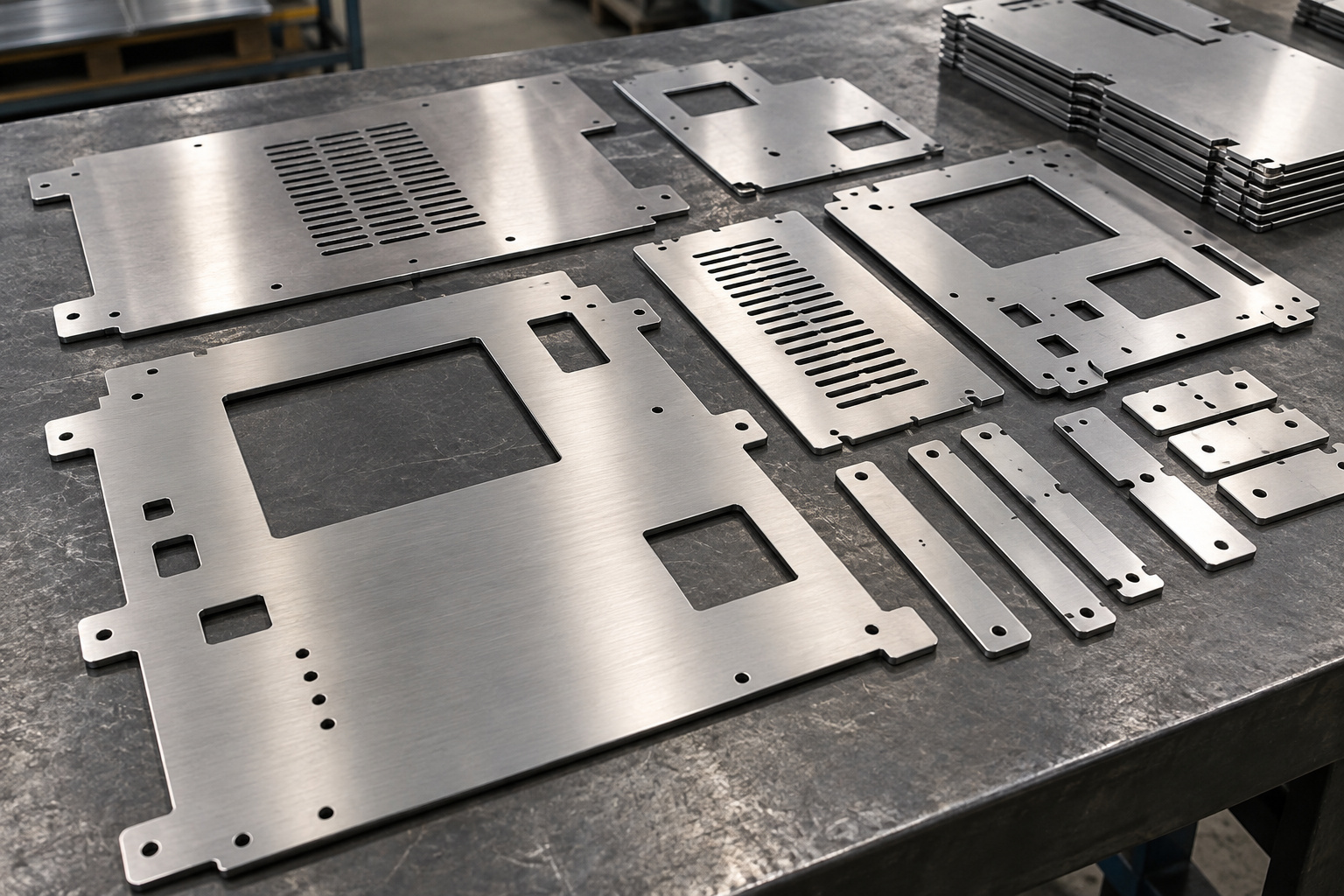
Stainless Steel Sheet Components
Laser cutting can produce suitable enclosure blanks, equipment panels, mounting tabs, and other stainless steel parts. Nitrogen cutting is often considered where an oxidation-limited edge is important.
Inspect small features, edge condition, and dimensions against the drawing. Cutting produces the flat geometry; bending, joining, surface finishing, and assembly remain separate operations where required.
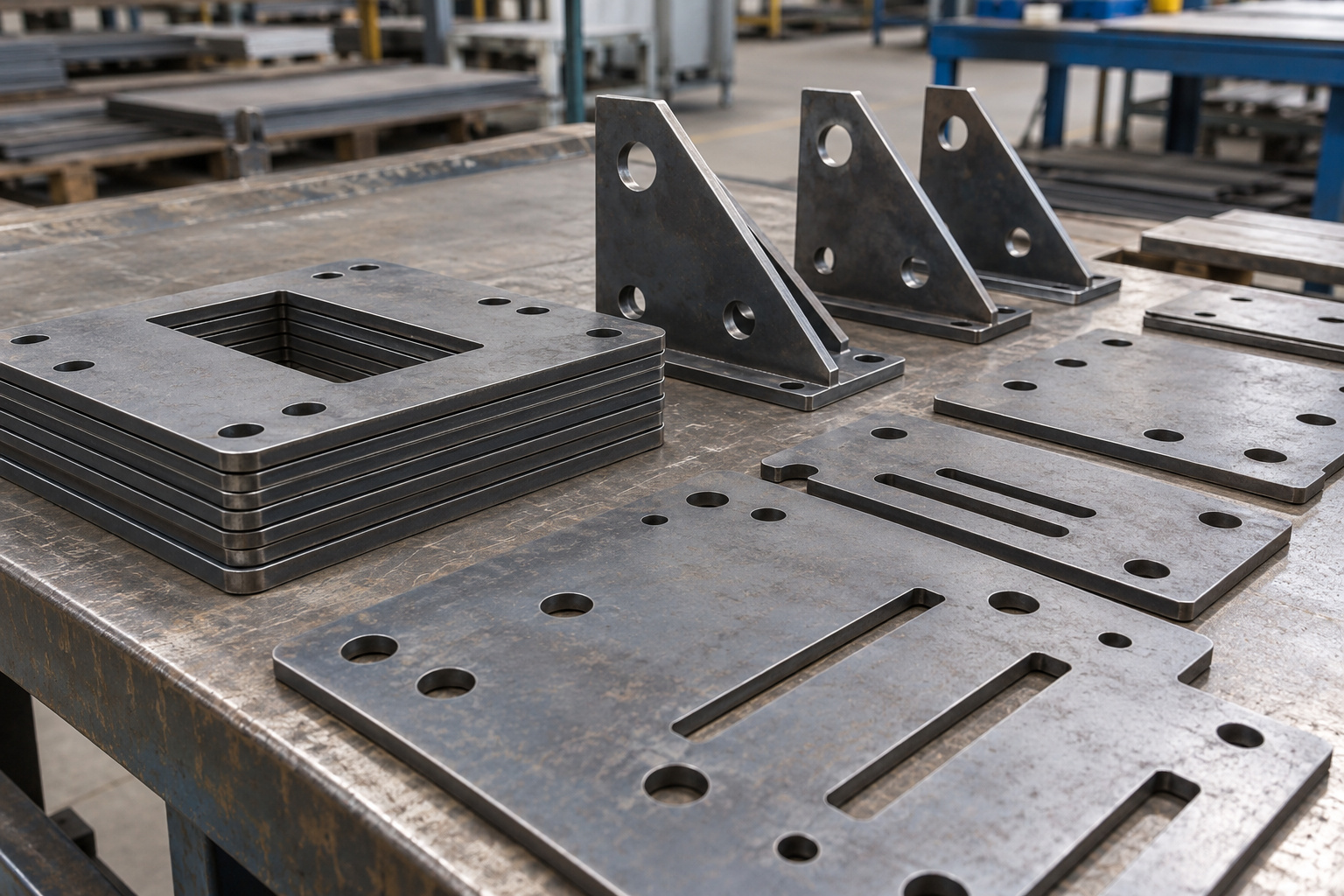
Carbon Steel Plates and Brackets
Carbon steel applications include mounting plates, bracket blanks, reinforcing profiles, and general fabrication parts. The appropriate gas and cutting process depend on thickness, throughput, edge requirements, and available equipment.
Precision holes and critical mating features may still require additional machining. Evaluate the finished part rather than assuming every laser-cut feature needs no further work.
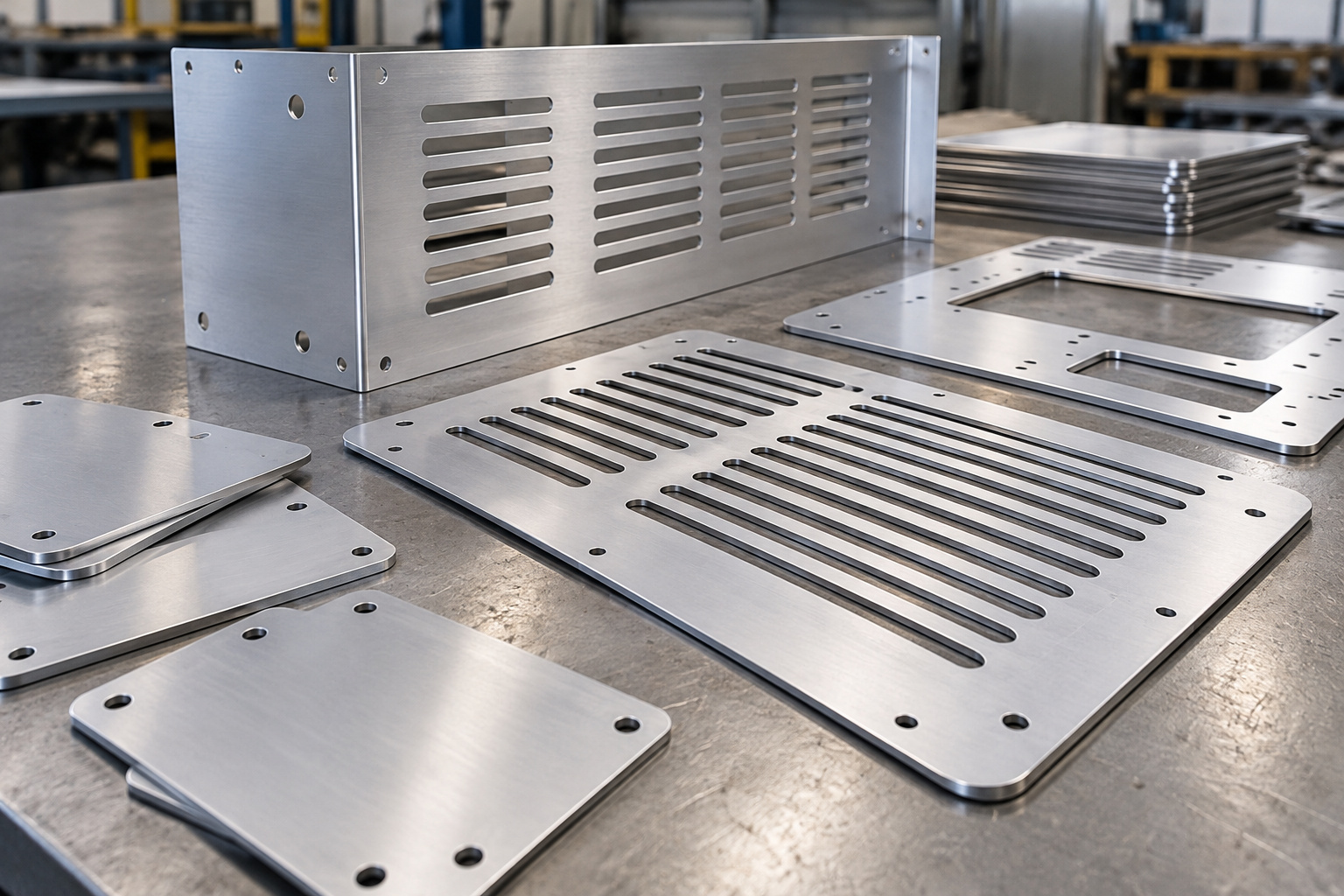
Aluminum Equipment Panels
Suitable fiber laser systems can cut aluminum panels, covers, and broad-profile components. Alloy, surface condition, thickness, and the approved process influence quality and production rate.
Check burrs, small-feature quality, and flatness. Thin panels can still distort or require deburring, even when the process is accurately controlled.
Decorative Metal Panels and Signage
Laser cutting can create decorative patterns and sign outlines in suitable sheet metals. Designers should consider minimum web width, internal features, support, and thermal effects.
Finished decorative panels may require deburring, coating, or other surface treatment after cutting. A completed architectural installation represents several fabrication steps, not the cutting operation alone.

What Determines Fiber Laser Cutting Quality?
Important variables include material grade and thickness, laser power, beam characteristics, focus, speed, assist gas, nozzle condition, and stand-off distance. Machine motion and part geometry also influence results.
Use the supplier’s process data as the starting point, then verify it with representative cuts. Inspect corners, holes, and narrow features as well as straight edges.
More power or higher speed does not automatically improve every job. Track acceptable parts and total processing time, including loading, piercing, unloading, cleanup, and inspection.
Fiber lasers are widely used for metal sheet cutting. CO2 systems use a different laser source and wavelength and are available for various metal or nonmetal applications depending on their design.
Plasma cutting uses an electrically conductive gas arc to melt metal. The choice between processes depends on the material, thickness, feature size, tolerances, finish, and production economics.
Compare representative parts on the proposed machines rather than relying on a blanket claim that one process is always faster, cheaper, or more accurate.
Provide your material grades, thickness range, sheet or tube sizes, drawings, required tolerances, and target output. Confirm whether the quoted equipment is intended for sheets, tubes, profiles, or a specified combination.
Evaluate the laser source, cutting head, motion system, working area, gas supply, cooling, extraction, protective features, software, maintenance access, and technical support.
Eastrise lists sheet-metal and other fiber laser cutting configurations. Ask for sample cuts on your actual materials and confirm the included equipment in the quotation. A combined sheet-and-tube machine should not be assumed to have every capability of a dedicated tube system.
Frequently Asked Questions
Does a fiber laser cutter use a physical blade?
No. A focused laser beam supplies the cutting energy, and assist gas helps remove material. The optical head operates above the workpiece rather than cutting with a contact blade.
Can a fiber laser cutting machine cut aluminum?
Yes, when the system and process are approved for the alloy and thickness. Request sample results for your actual material and part geometry.
How thick can a fiber laser cutter cut?
Capacity depends on the metal, laser source, power, head, gas process, and acceptable quality. Confirm production cutting and piercing capability separately.
Can one machine cut both sheet metal and tubes?
Only if it has the required workholding, motion, controls, and processing capability. A standard sheet cutter does not automatically provide tube cutting.
Does laser cutting eliminate all finishing?
No. Deburring, oxide removal, precision machining, coating, or other operations may still be needed according to the finished-part requirements.
Final Thoughts
A fiber laser cutting machine works by generating laser energy, delivering and focusing it onto the material, clearing the cut with assist gas, and following a CNC toolpath. Reliable results depend on the complete process and equipment configuration.
Contact Eastrise with your materials, drawings, and production requirements to discuss a suitable fiber laser cutting solution and sample evaluation.


 English


