How to Choose an ATC CNC Router for Cabinet Making
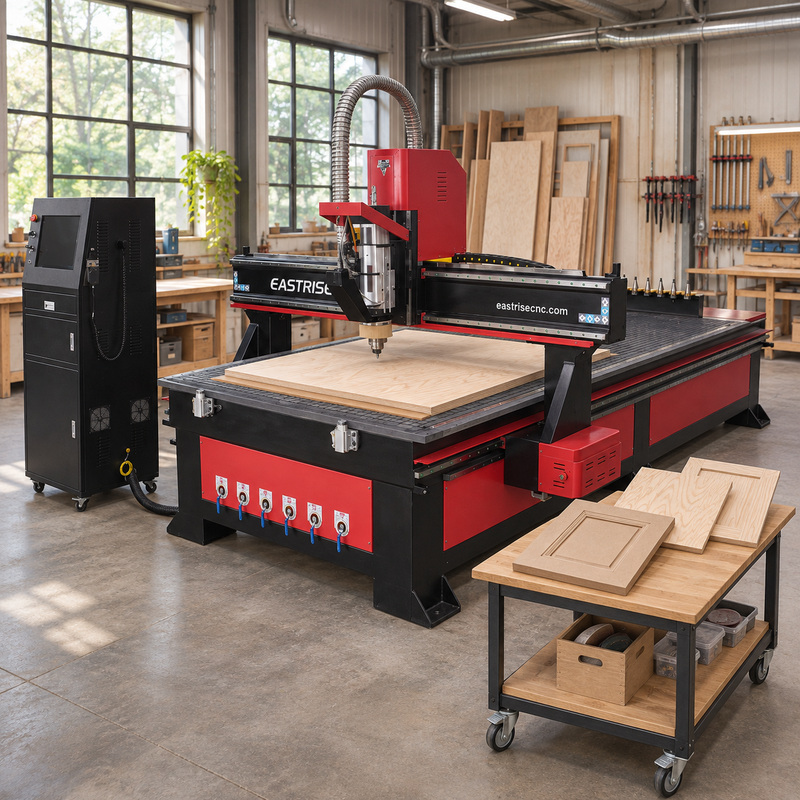
An ATC CNC router is a computer-controlled routing machine that changes cutting tools automatically during a programmed job. For cabinet manufacturers, this allows cutting, grooving, drilling, and door profiling to be combined with fewer manual tool changes.
Choosing the right machine starts with your parts, materials, and production process. Table size, workholding, tool capacity, and drilling requirements all matter. A larger spindle or more tool positions alone does not establish whether a machine is suitable for your workshop.
ATC stands for automatic tool changer. Different cutters are stored in a tool magazine, and the controller selects the tool required for each programmed operation.
For example, a cabinet job might use one cutter for panel outlines, another for grooves, and a third for a decorative door profile. An ATC system can switch between these tools without requiring an operator to replace each cutter manually.
Automatic tool changing reduces interruptions between operations; it does not remove the need for correct programming, tool setup, and material fixing.
Cabinet Parts You Can Produce
Cabinet Body Panels
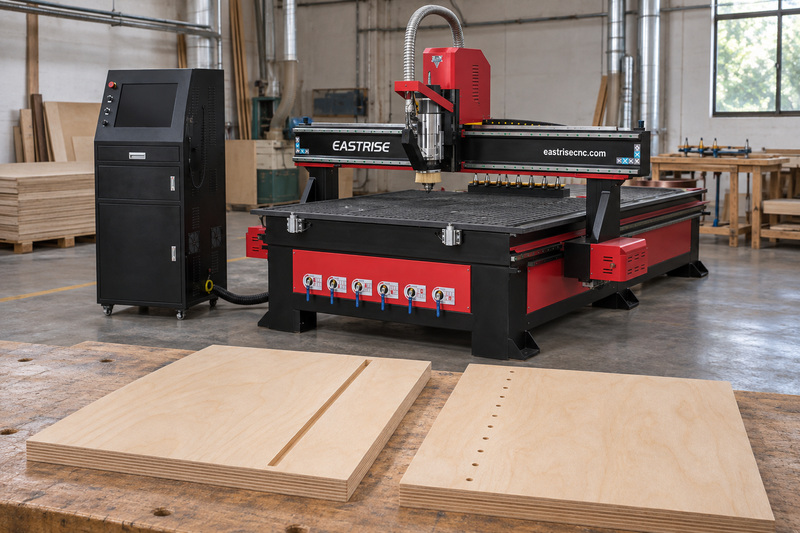
An appropriately configured machine can cut cabinet sides, shelves, partitions, and other flat components from sheet materials. Grooves and suitable vertical holes can be machined while the sheet remains on the table.
Check whether holes must enter from the panel face or the edge. A standard three-axis vertical spindle does not automatically provide horizontal edge drilling. Additional equipment or another setup may be required.
MDF Cabinet Doors
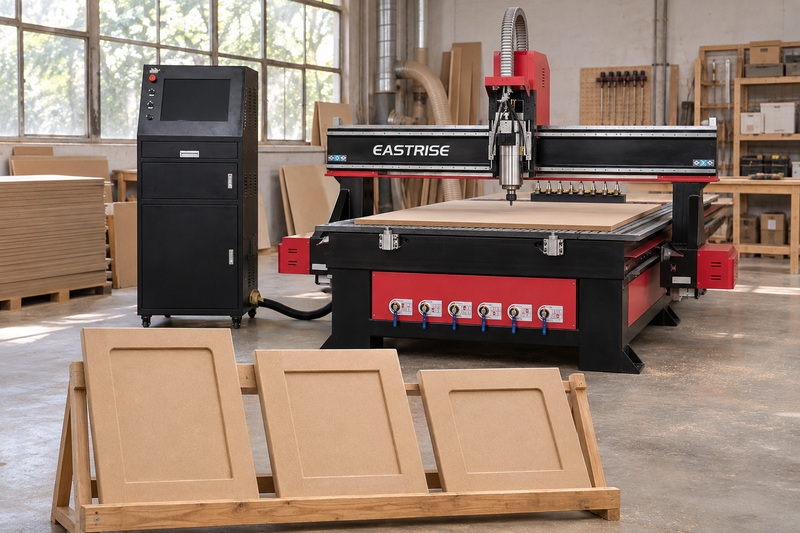
ATC routing is useful when a door design requires several cutters for recesses, profiles, or decorative details. Tool selection should follow the drawing, desired finish, and material.
MDF doors still require the appropriate sanding, sealing, and finishing process after machining. A routed surface is not a finished painted surface.
Plywood Cabinet Components
Plywood can be routed into cabinet panels and furniture components with suitable cutters and workholding. Inspect both faces and the exposed edge when assessing sample quality.
Judge the actual material you plan to purchase. A successful sample in one plywood grade does not establish the same edge quality in every grade or coating.
Linear vs. Carousel Tool Changers
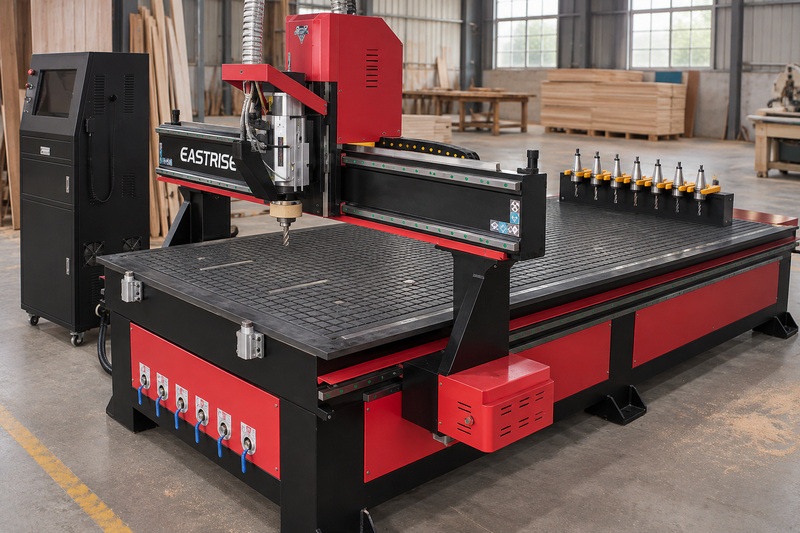
A linear magazine stores tools in a row. A carousel magazine stores tools around a rotating disc. EASTRISE offers examples of both arrangements.
| Comparison | Linear tool changer | Carousel tool changer |
| Tool arrangement | Tools stored in a row | Tools stored around a disc |
| Layout to inspect | Magazine position and access | Magazine position, movement, and clearance |
| Timing to compare | Travel and exchange time in your program | Indexing, travel, and exchange time in your program |
| Selection basis | Required tools, layout, and full job time | Required tools, layout, and full job time |
Compare complete machining cycles instead of assuming one magazine style is always faster. Magazine location, controller behavior, and the sequence of operations affect the result.
Confirm how many tool positions are included in the quoted machine. Also check toolholder compatibility and limits on cutter diameter, length, and weight.
How to Choose the Right Configuration
Match the Table to Your Sheets
Specify the largest sheet you regularly process and ask for the usable machining area. Allow for your intended positioning and fixing method.
Check loading access and space around the machine. If automatic loading or unloading is required, confirm that it is included in the proposed system.
Check Workholding on Small Parts
Vacuum tables can hold sheet materials, but their performance depends on the table, spoilboard, material, and remaining contact area. A large sheet and a small separated component present different holding conditions.
Ask the supplier to demonstrate your smallest representative part through the final cut. Discuss any additional holding strategy needed before approving production.
Specify Drilling Requirements
List hole diameters, depths, directions, and quantities. Repeated vertical drilling may justify evaluating a dedicated boring head, while occasional holes may be handled with appropriate spindle tooling.
Ask which operations the proposed configuration performs in one setup and which require repositioning or another machine.
Confirm Software Compatibility
A drawing file is only the starting point. The workflow must generate suitable toolpaths and machine code for the selected controller.
Confirm the CAD/CAM software, postprocessor, tool numbering, and tool-length setup procedure. If nesting software is included, clarify its functions, license terms, and training scope.
Plan Extraction and Utilities
Confirm the electrical supply, compressed-air requirements, vacuum equipment, and dust extraction needed for the exact machine configuration.
Allow access for cleaning, tool changes, and maintenance. Request the operating and maintenance documentation before installation.
A Practical Cabinet Production Workflow
Prepare the cabinet drawings and identify material thicknesses.
Create the layout and toolpaths in compatible software.
Load and secure the sheet using the approved holding method.
Verify the program, tools, offsets, and clearances.
Machine features in a sequence that maintains adequate part support.
Remove and identify the components after the machine has stopped safely.
Complete any separate drilling, edge banding, finishing, and assembly.
An ATC CNC router handles selected machining operations within a wider cabinet production process. Its value depends on how well those operations connect to the next production steps.
What to Check During a Sample Test
Send the supplier a representative drawing and the actual material specification. Include a small component, a groove, and any critical drilling or door details.
Assess dimensions, hole positions, both-face edge quality, and the fit of mating components. Record tool changes, loading, machining, and unloading when comparing job times.
Agree on acceptance criteria before the test. A useful demonstration shows parts that meet your requirements and a process your workshop can repeat.
Frequently Asked Questions
Is an ATC CNC router suitable for a small cabinet workshop?
It can be suitable when jobs use several tools or frequent manual changes interrupt production. Compare the time saved and required investment against your actual workload.
Can an ATC CNC router cut, groove, and drill in one program?
Yes, with suitable tooling, software, and machine configuration. Hole direction and access determine whether every required operation is possible in one setup.
Does a larger spindle guarantee better cabinet parts?
No. Part quality also depends on tooling, workholding, programming, material consistency, and machine condition. Evaluate a sample rather than selecting by spindle power alone.
What should I send when requesting a quotation?
Provide sheet dimensions, materials, thicknesses, part drawings, drilling requirements, expected workload, and available utilities. State whether loading equipment, software, extraction, and training should be included.
Discuss Your Cabinet Machining Requirements with EASTRISE
EASTRISE offers ATC CNC router configurations for woodworking applications. To discuss a suitable option, prepare your cabinet drawings and material details.
Request a configuration proposal and a representative sample test before making a final selection. This helps establish which operations can be completed on the proposed machine and what additional production steps remain.


 English



